Raytheon's $24.4 Billion SM-6 Contract: What It Means for Tucson Jobs
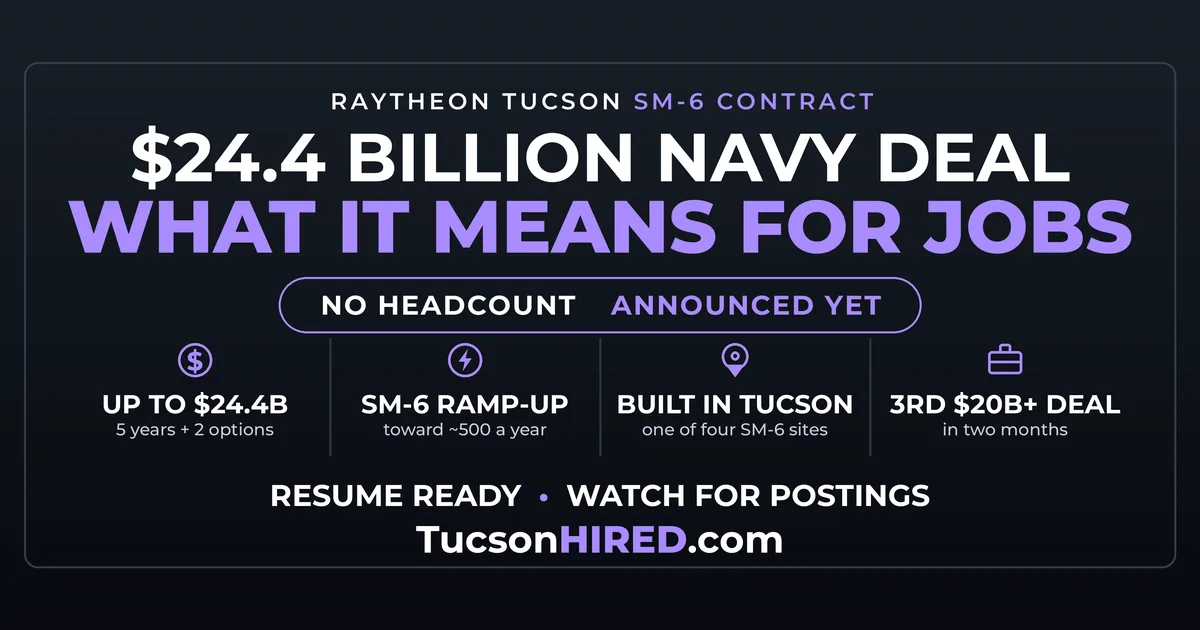
TUCSON, AZ — The Navy just handed Raytheon its largest contract yet, topping August's record Tomahawk deal, and Tucson builds a big piece of what it buys. On October 1, the Navy awarded Raytheon a contract worth up to $24.4 billion for Standard Missile-6 interceptors, a five-year deal with two more option years. No Tucson hiring number came with it, but it's the third Raytheon deal over $20 billion in two months, and Tucson has a stake in all three.
More missiles, more production, more pressure on Tucson's defense workforce. Here's what job seekers should watch for.
In a hurry? Skip straight to the job links and begin searching now →
📍 The SM-6 Contract at a Glance
| Company | Raytheon, an RTX business |
|---|---|
| Customer | U.S. Navy |
| Announced | October 1, 2026 |
| Value | Up to $24.4 billion (a ceiling, not guaranteed funding) |
| Term | Five years, plus two option years |
| Product | Standard Missile-6 (SM-6) interceptors |
| Where SM-6 is built | Raytheon sites in Tucson; Huntsville, Ala.; Andover, Mass.; and Diné, N.M. |
| New Tucson jobs | Not announced |
What the Navy Bought
SM-6 is a ship-launched missile that can do three jobs: shoot down aircraft and cruise missiles, hit ships, and knock out ballistic missiles in their final seconds. Raytheon calls it the only combat-proven weapon that does all three, and the Navy has been firing them in combat. The Pentagon is working to rebuild munitions stockpiles drawn down by fighting in the Middle East this year.
USNI News reported the deal could cover upwards of 1,900 missiles, though neither the Navy nor Raytheon has given an exact count. It builds on framework agreements signed in February that set the SM-6 line on course for roughly 500 missiles a year. Chief of Naval Operations Adm. Daryl Caudle said the award "gives industry the demand signal and stability to expand production."
One caution: $24.4 billion is a ceiling. Defense News reported that Congress hasn't yet appropriated the money for these multiyear deals, and industry executives say that can slow how fast contractors invest in plants and people.
Where Tucson Fits
Raytheon lists Tucson first among the four sites that build SM-6, ahead of Huntsville, Andover and Diné. The Tucson connection runs through the paperwork, too. In January, a Navy contract to buy tooling and test equipment to boost SM-6 production capacity assigned 47% of that work to Tucson, the largest share of any site.
SM-6 isn't the only line here getting bigger. In August, Raytheon landed a seven-year, $22.9 billion deal for Tomahawk cruise missiles, which are built in Tucson, with a target of more than 1,000 a year. On September 28, a Tucson-datelined Raytheon release announced a $20.7 billion contract for AMRAAM air-to-air missiles. AZPM reported the Pentagon expects that deal to create about 3,000 aerospace manufacturing jobs in Tucson and elsewhere, without a local breakdown.
So Is Raytheon Hiring?
Raytheon hasn't announced a Tucson hiring target tied to SM-6. What it has said is that it's growing its skilled workforce, building stronger supplier partnerships and automating production to keep up with demand. In early September, it held back-to-back Tucson hiring events, one for engineering, digital, finance and quality jobs and one for machinists, electricians and technicians.
Translation: don't wait for an announcement. Higher production targets usually show up as a steady flow of postings rather than one big press release. Raytheon lists its openings on its official careers site.
What It Means for Tucson Job Seekers
Missile production takes engineers, but it takes far more people on the floor, in the lab and in the supply chain. These are the kinds of roles a production ramp leans on. They reflect the work, not a confirmed list of openings:
- Engineers: systems, electrical, mechanical and manufacturing engineers. Aerospace engineer careers, systems engineer careers and manufacturing engineer careers
- Electronics assemblers and technicians: building and testing guidance and electronics hardware. Electronics assembler careers and defense electronics technician careers
- Machinists: making precision parts for airframes and components. CNC machinist career guide
- Quality inspectors: checking parts and paperwork against tight specs. Aerospace quality inspector careers
- Composites technicians: working with advanced materials. Composites technician careers
- Maintenance techs: keeping production equipment running. Industrial maintenance technician careers
- Supply chain and materials: moving parts from hundreds of suppliers onto the line. Supply chain coordinator careers and material handler careers
Before you apply, know this: many Raytheon jobs require U.S. citizenship because of export-control rules, and some require a security clearance or the ability to get one. Each posting spells out its requirements.
The Ripple Effect Beyond Raytheon
Raytheon says it works with hundreds of small and mid-sized suppliers on its missile programs. When the big lines speed up, the machine shops, coating houses and electronics firms around the airport feel it too. That's part of why newer shops like Albers Aerospace, which is adding 24 defense manufacturing jobs on the south side, keep choosing Tucson. For the bigger picture, our 2026 aerospace and defense hiring guide covers RTX, Davis-Monthan and the rest of the sector.
🔎 Search Jobs Now
- Raytheon jobs in Tucson
- Aerospace jobs in Tucson
- Defense jobs in Tucson
- Engineer jobs in Tucson
- Electronics assembler jobs in Tucson
- Machinist jobs in Tucson
- Quality inspector jobs in Tucson
- Security clearance jobs in Tucson
Browse the Aerospace, Engineering and Manufacturing guides in the TucsonHIRED Career Center for role-by-role details.
Want the next Raytheon posting in your inbox? Create a free TucsonHIRED account and set job alerts for aerospace, engineering and manufacturing roles.
📢 Employers: Competing With Raytheon for Talent?
When the region's biggest defense employer ramps up, every shop in its supply chain feels the squeeze for engineers, machinists and assemblers. Post your openings on TucsonHIRED and reach local candidates directly.
❓ Frequently Asked Questions
What is Raytheon's $24.4 billion SM-6 contract?
On October 1, 2026, the U.S. Navy awarded Raytheon a multiyear contract worth up to $24.4 billion for Standard Missile-6 interceptors. It runs five years with two option years.
Is the SM-6 built in Tucson?
Yes. Raytheon builds SM-6 at facilities in Tucson, Huntsville, Ala., Andover, Mass., and Diné, N.M.
Will the contract create new jobs in Tucson?
Raytheon hasn't announced a Tucson hiring number tied to the SM-6 contract. The company says it's growing its skilled workforce to meet demand, so watch for new postings rather than a single announcement.
Is the full $24.4 billion guaranteed?
No. It's a contract ceiling. Congress still has to appropriate the funding year by year.
What other big contracts has Raytheon won recently?
A seven-year, $22.9 billion Tomahawk cruise missile contract in August 2026 and a $20.7 billion AMRAAM air-to-air missile contract in late September 2026.
Do Raytheon jobs require a security clearance?
Some do. Many Raytheon positions require U.S. citizenship because of export-control rules, and some require a clearance or the ability to obtain one. Each posting lists its requirements.
From the Raytheon campus by Tucson International Airport to the shops ringing it, this town has been building missiles for the Navy for decades. The orders just got bigger. Keep your resume current and your job alerts on.